Oden: how to order and enjoy it at an izakaya
What oden is, ordering piece by piece or as a platter, sharing tips, the most popular pieces, karashi mustard, the broth, and dashi-wari — hot sake topped up with oden broth.
Oden (おでん) is daikon radish, eggs, fishcakes and more, simmered for a long time in a light, savoury broth. It’s warming, gentle on the stomach and goes well with a drink, so you’ll find it at many izakaya — especially in the colder months — and at oden shops that serve little else. Knowing a bit about how to order and eat it makes it even more fun.
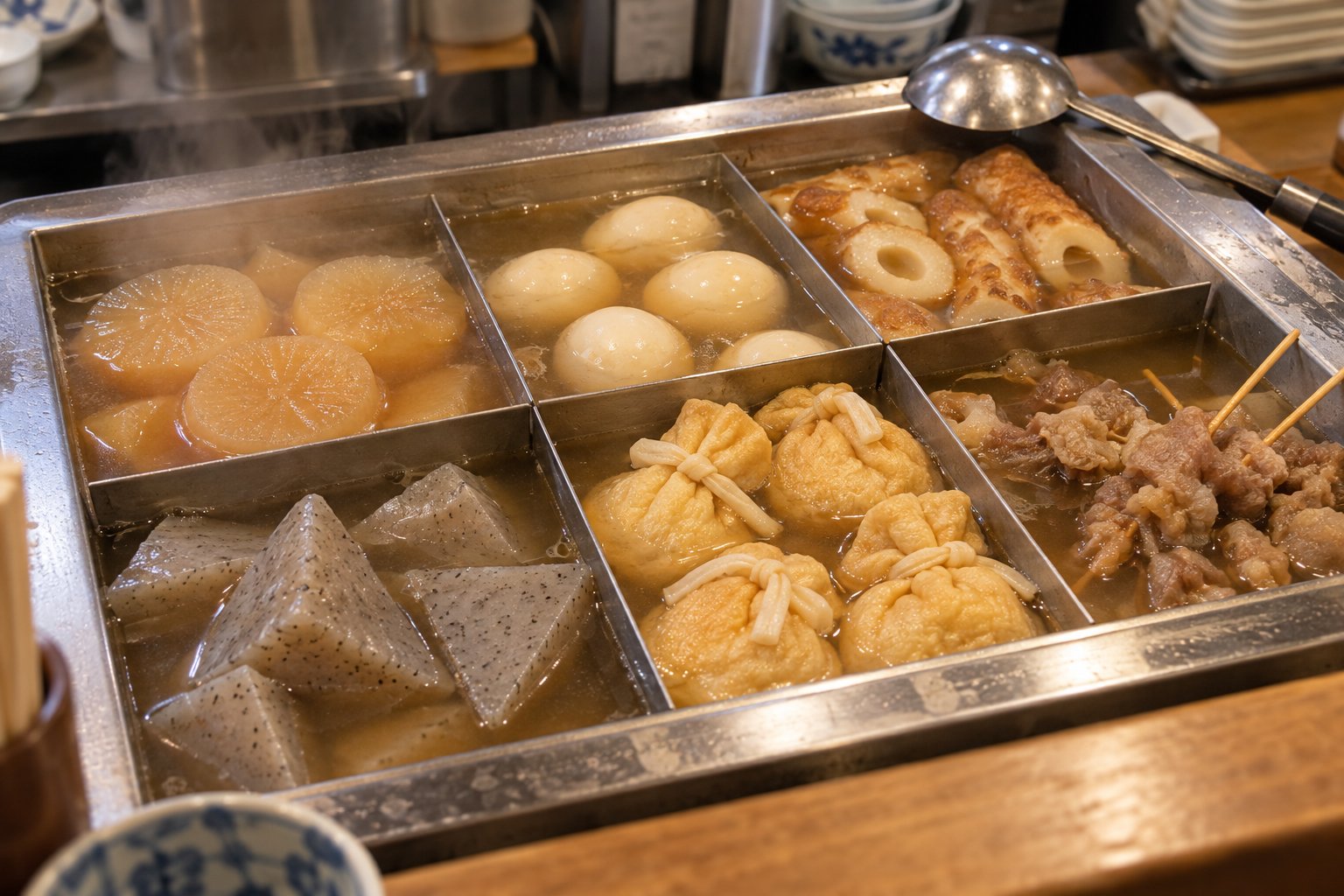
What oden is
Oden is a simmered dish. Each piece cooks slowly in dashi broth — usually made from bonito flakes and kelp and seasoned with soy sauce — until it soaks up the flavour. There’s no sauce to add: the taste is in the broth.
The name comes from dengaku, an old dish of tofu on skewers. Over time, dengaku came to mean the grilled version and oden the simmered one. In the Kansai region (around Osaka) you may also hear oden called kantodaki (関東煮), “Kanto-style simmered dish”.
How to order
At an izakaya, oden usually has its own place on the menu under おでん. You can order pieces one at a time, and many places also have an assorted platter (moriawase, 盛り合わせ). If you’re not sure what to pick, the platter is an easy place to start.
At an oden shop, the pot often sits right at the counter, so you can see what’s cooking and point to what you’d like. A nice way to enjoy it is to start with a few pieces and add more as you go. They come in a bowl with some of the broth.
Sharing or one each
Oden works either way. If you’re sharing, soft pieces like daikon and egg are easy to cut with your chopsticks. Konnyaku, chikuwa and mochi kinchaku are harder to split, so it’s a good idea to order one for each person.
Small plates (torizara) make sharing easier — everyone can take a piece with a little broth. Oden holds a lot of broth, so it helps to lift your plate or bowl closer when you eat.
Popular oden pieces
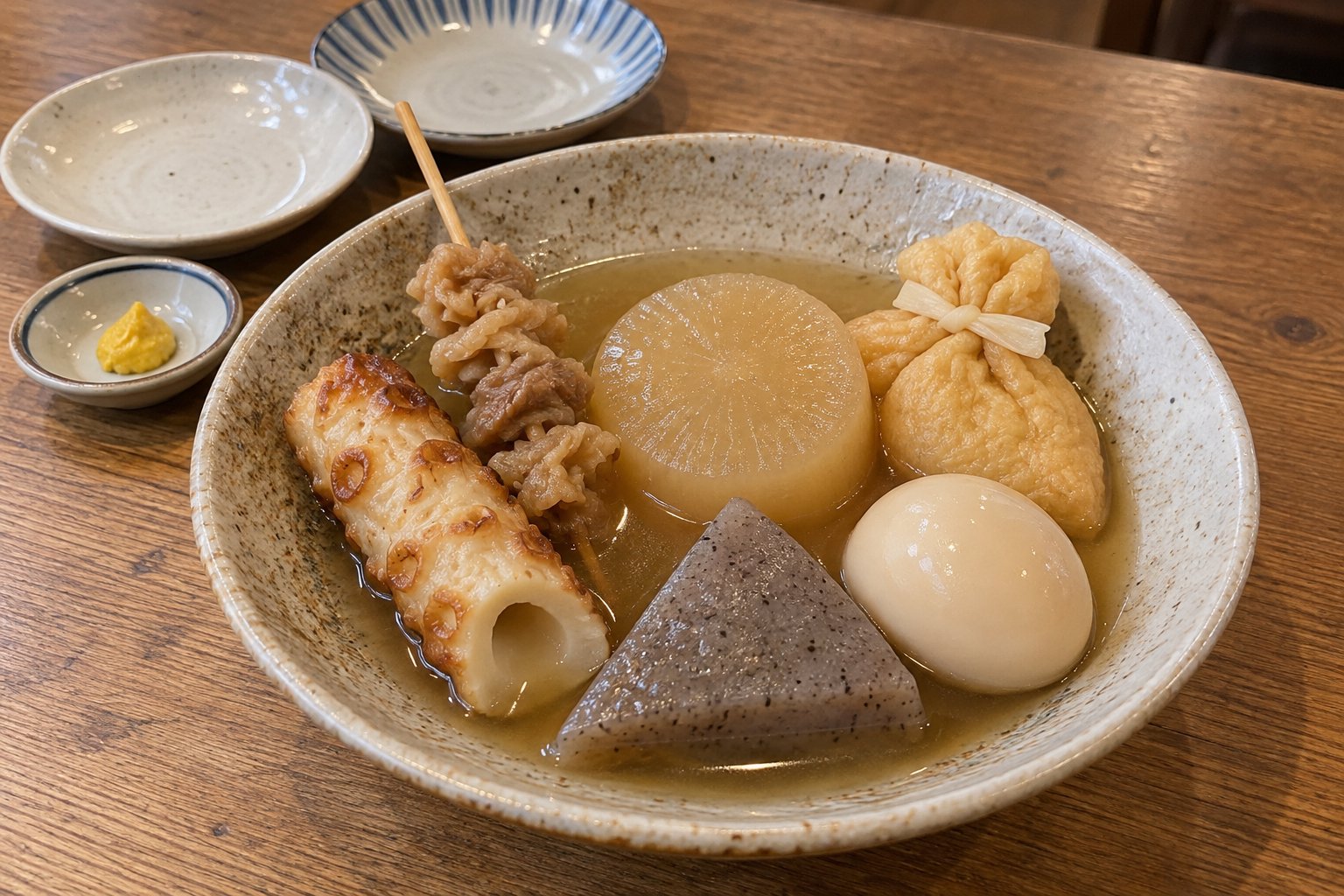
In a nationwide survey by LINE Research (2021, about 5,000 people), the three favourite pieces were daikon, egg and mochi kinchaku — a good place to start.
- Daikon (大根) — thick rounds of radish, soft and full of broth.
- Egg (たまご) — hard-boiled, then simmered until the white turns light brown.
- Mochi kinchaku (餅巾着) — a fried tofu pouch with sticky rice cake inside, tied at the top.
- Gyūsuji (牛すじ) — beef tendon on a skewer, rich and tender. Especially popular in western Japan.
- Chikuwa (ちくわ) — a tube-shaped fishcake, browned on the outside.
- Chikuwabu (ちくわぶ) — looks like chikuwa but is made from wheat flour, with a chewy texture. Mostly found around Tokyo.
- Hanpen (はんぺん) — a soft, fluffy white fishcake.
- Konnyaku (こんにゃく) — a firm, jelly-like block made from konjac, often cut into triangles. Shirataki are konjac noodles tied in a bundle.
- Atsuage and ganmodoki (厚揚げ・がんもどき) — thick fried tofu, and fried tofu patties with bits of vegetable.
- Satsuma-age and tsumire (さつま揚げ・つみれ) — fried fishcakes, and soft fish balls.
If you avoid fish or meat, it’s worth knowing that all the pieces simmer together in one pot, and the broth is usually made with bonito flakes. Even daikon and egg take on the flavour of everything else in the pot.
Karashi: a little goes a long way
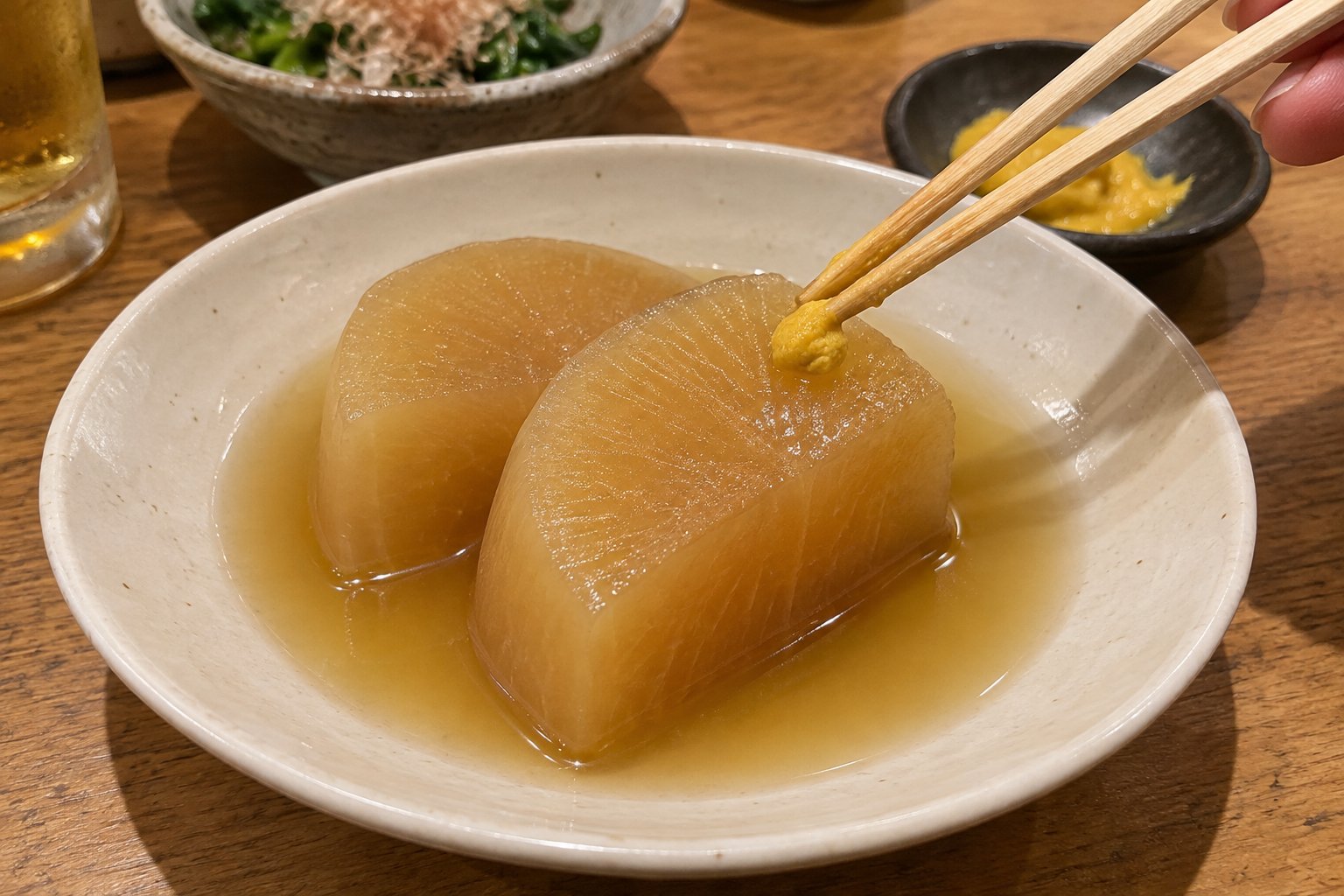
Oden often comes with karashi (からし), Japanese mustard. It’s much hotter than most Western mustards and goes straight to your nose, a bit like wasabi.
A good way to try it is to pick up a little with your chopsticks and put it on a piece of oden, then add more if you like. If you stir it into the broth, the whole bowl turns spicy, so starting with a small amount on one bite is easier.
The broth
The broth is half the pleasure of oden, so feel free to sip it from the bowl between pieces.
Its colour depends on the region. Around Tokyo (Kanto) it’s usually bonito-based with dark soy sauce, so it looks darker. Around Osaka and Kyoto (Kansai) it’s kelp-based with light soy sauce, so it’s paler. Either way, it soaks into every piece — that’s why daikon that has simmered for a long time tastes so good.
Dashi-wari: oden broth in your sake
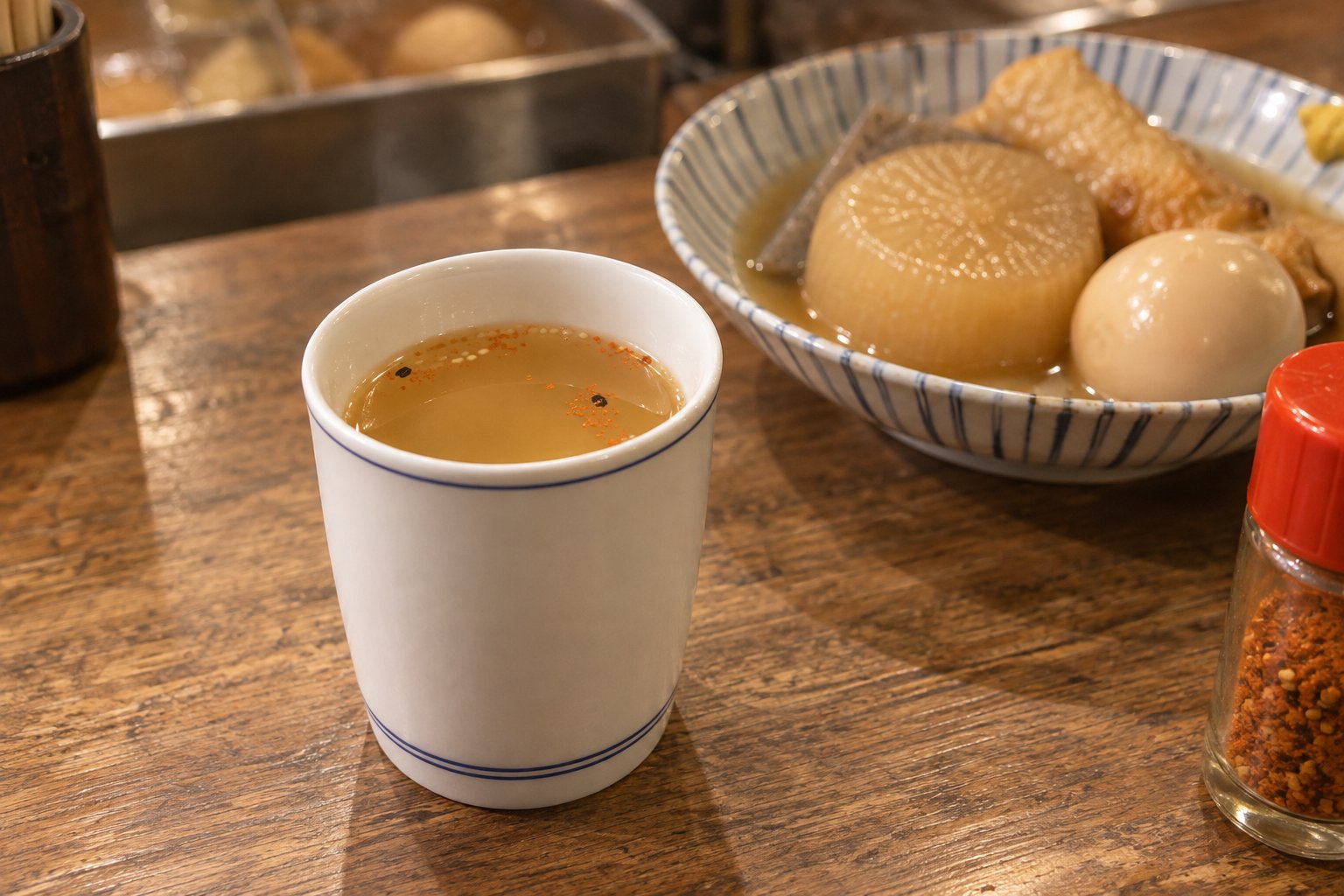
Dashi-wari (出汁割り) is hot sake mixed with oden broth. It was a popular way to drink in the Shōwa era (1926–1989) and is less common today, but some oden shops still serve it, sometimes as a small add-on to your sake. Some shops make it with shochu instead.
The broth makes the sake mellow and savoury. A pinch of shichimi, the Japanese chili pepper mix, gives it a nice kick.
Related guides
- How to enjoy yakitori: salt or sauce, shichimi and the skewer cupHow to order yakitori by the skewer, salt versus tare, what to sprinkle on it, where the used skewers go, and whether to take the meat off the stick.
- How an izakaya works: a first-timer's guide to the nightFrom your first drink to the bill — what happens at a Japanese izakaya, in order, so nothing catches you off guard.
- Izakaya phrases: Japanese to get you through the nightThe Japanese you'll actually use at an izakaya, from walking in to paying. Tap any phrase to show it to staff full screen.